
Larval Biology Basics
What is a larva?
The beginning stage, or baby, of many animals that does not look like the adult
Human babies have the same basic features as adults (such as fingers, toes, nose, eyes), but butterflies do not look much like their caterpillar babies. Neither do frogs look much like tadpoles. These animals have indirect development, in which a larval form (baby) undergoes a dramatic change called metamorphosis to take on the adult form. Metamorphosis is Greek for “transformation” and often involves a change in both behavior and anatomy.

Life cycle of a butterfly. Images from the Charleston Marine Life Center Larval exhibit.
Marine larvae are tiny and diverse
Like butterflies and other insects, many marine animals lack backbones and are called invertebrates. The larvae (plural of larva) of marine invertebrates are microscopic, and many are smaller than the period at the end of this sentence.
Larvae are considered plankton, which includes any organism not strong enough to swim against the current. For larvae, their size means they are planktonic, living at the whim of the waves. Pictured here is a selection of diverse larvae. Their unique structures and traits allow marine biologists to determine which larval form will metamorphose into which adult.
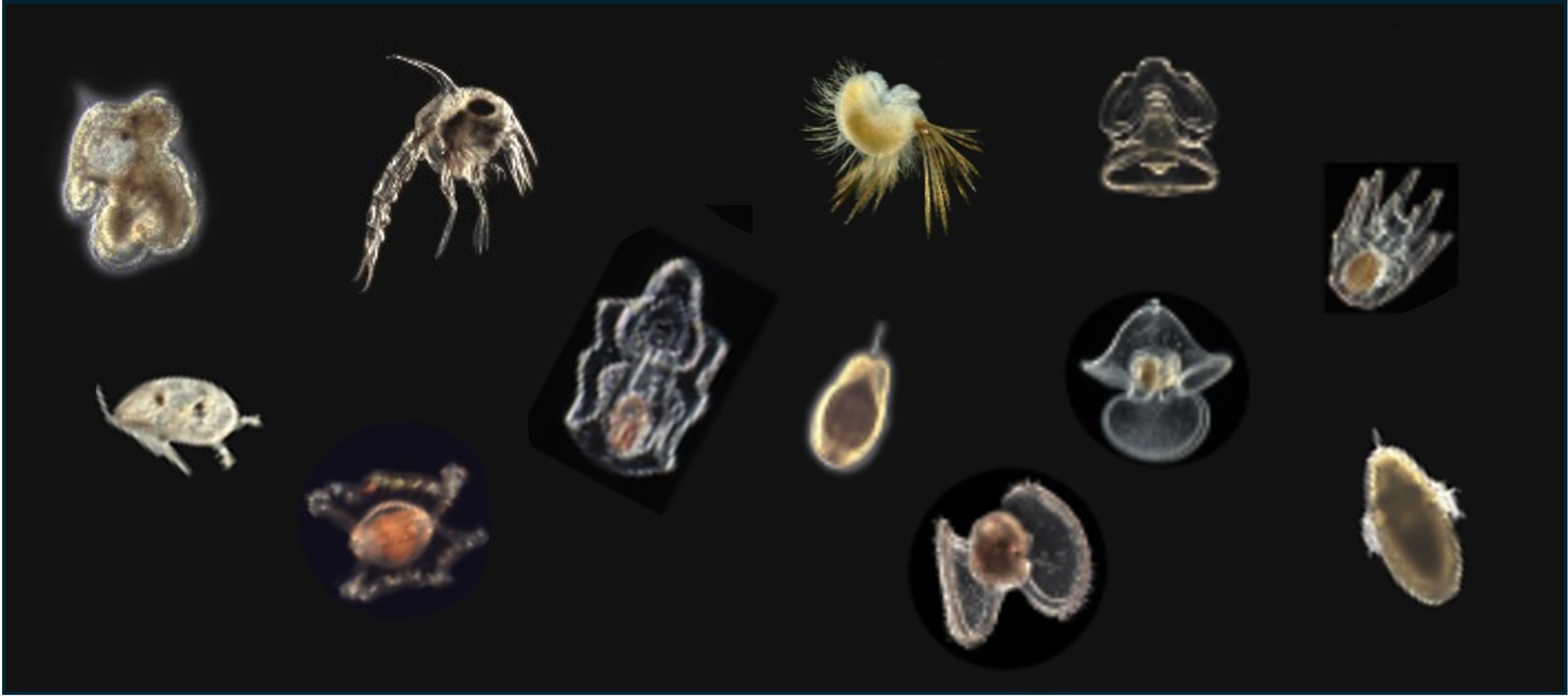
Collage showing the diverse forms of marine larvae. Images by Dr. George von Dassow, Nadia Stoker, & Dr. Caitlin Plowman.
How do larvae live?
Larvae use hair-like cilia to move water around them
At their small size, moving through the ocean for a larva is like swimming through honey for a human. To move and feed in this environment, they typically have dense cilia, hair-like projections that beat to create small currents around the larva’s body. The image below shows a pluteus larva of a brittle star and the currents formed around its body by the movement of its cilia.
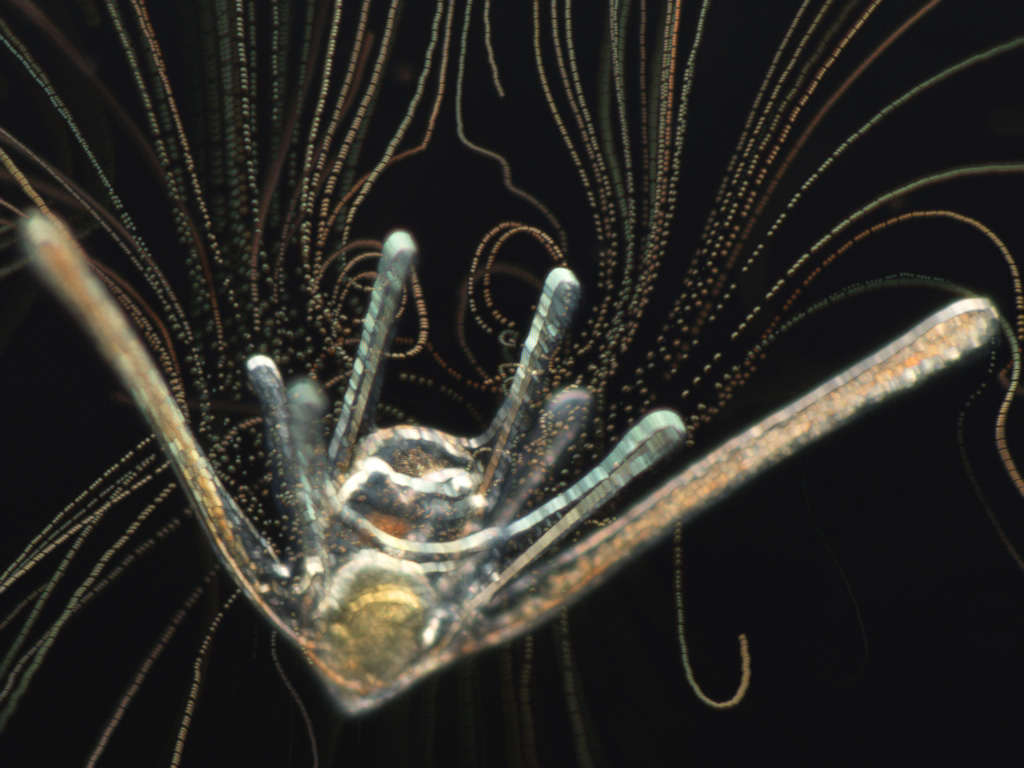
Picture showing currents around a Pluteus larva generated by the movement of the larva’s cilia.
Image by Dr. George von Dassow.
Many, but not all, larvae feed
Larvae that need to feed to reach metamorphosis are called planktotrophic. Typically, planktotrophic larvae eat microscopic algae called phytoplankton. Some also eat other microscopic animals known as zooplankton. Some larvae do not feed and instead grow from the nutrients in the yolk of their egg. Non-feeding larvae are called lecithotrophic. Planktotrophic spend more time in the plankton causing them to disperse further away from their parents than lecithotrophic larvae. Planktotrophic larvae are more common as you can see in the color-coded image below.
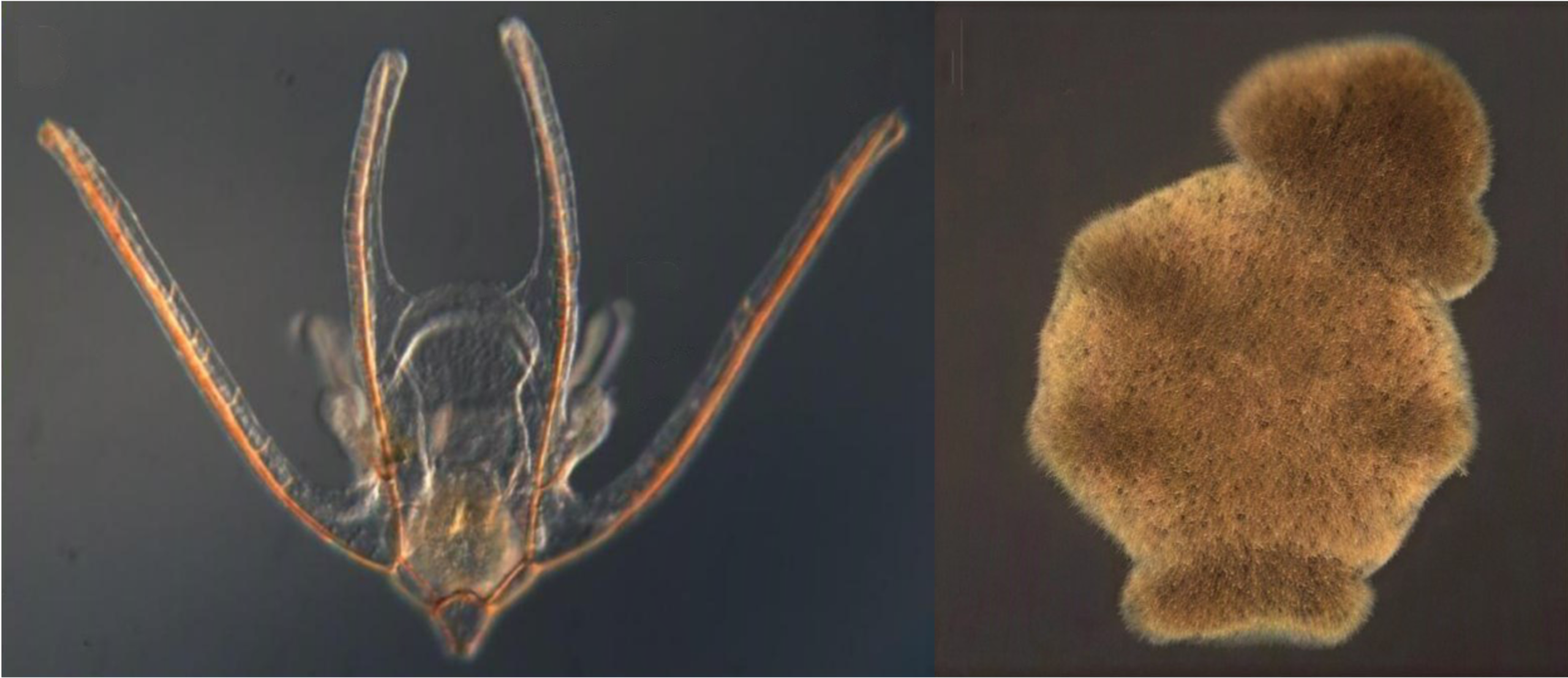
Comparison of a feeding (planktotrophic) larva on the left and a non-feeding (lecithotrophic) larva on the right.
Both larvae grow into brittle stars. Images from Nakata & Emlet, 2026.
How many larvae are there?
The number of babies decreases as the mom's effort increases
In species with planktotrophic larvae, eggs are small as they only contain enough energy to develop a feeding larva. A single mom can produce hundreds of thousands to millions of these small eggs.
In lecithotrophic species, eggs are larger and contain enough energy for the larva to reach metamorphosis. Moms of these species only make hundreds to tens of thousands eggs.
Parents of some species invest even more energy by brooding, or protecting their developing babies. These species produce the fewest (tens to hundreds) and largest eggs of the three groups discussed.
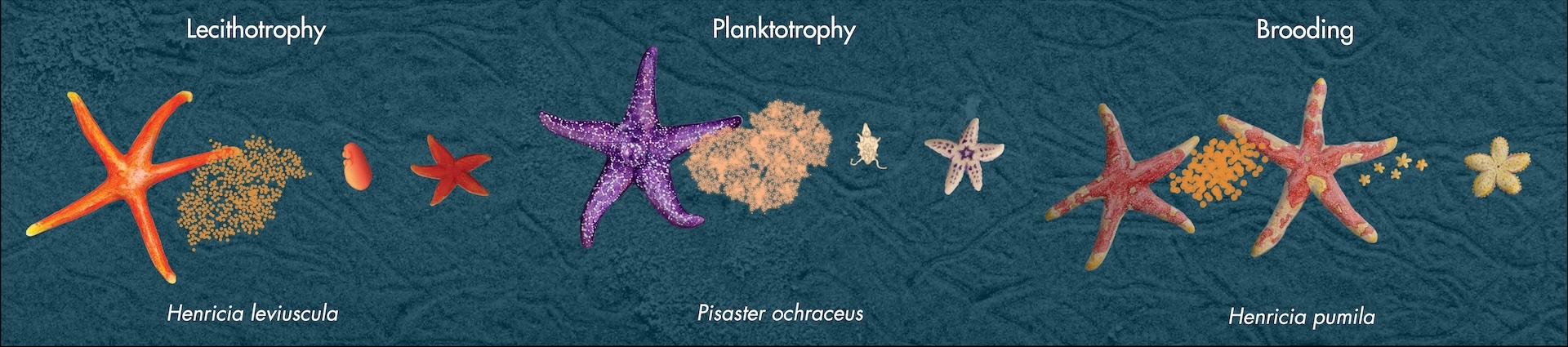
Illustration of how egg sizes and numbers correspond to the feeding mode of the resulting larvae.
Image from the Charleston Marine Life Center Larval exhibit.
Most marine larvae are in surface waters
Approximately 170,000 marine species worldwide possess a larval stage. A single drop of surface ocean water may contain the larvae of several marine invertebrates.
However, the number of larvae decreases with increased ocean depth. Larvae are mostly found in the sunlit suface waters where their phytoplankton food is found. When searching for the larvae of deep-sea animals, scientists can filter thousands of liters of water to find only a few larvae.
The image below shows a plankton sample from surface waters viewed under a microscope. There is a lot of phytoplankton which create the green and yellow colors and are often seen as small lines. Most of the image would be clear if it were of a deep water sample.
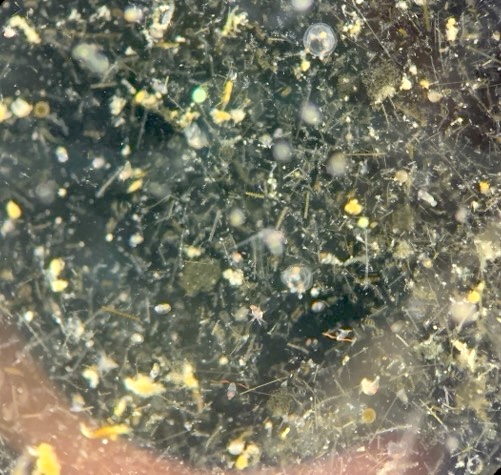
Plankton collected from surface waters, as viewed through a microscope. Photo by Dr. Nicole Nakata.
Information and visuals in the Larval Biology Basics section were adapted from the larval exhibit at the University of Oregon’s Charleston Marine Life Center.
Project Team
Movie produced by The Stephen Low Company
Website and content development by Nadia Stoker, Dr. Caitlin Plowman, and Trish Mace
Oregon Institute of Marine Biology & Charleston Marine Life Center, University of Oregon
The film is partially funded by the U.S. National Science Foundation (award #2215692).
All Larval Quest materials are licensed under creative commons license CC BY-NC-SA 4.0.