

FAST TRAIN
A GIANT SCREEN PRODUCTION
The Film
Captured for the giant screen, Fast Train follows the evolution of Canada’s Alto high-speed rail system and puts audiences in the centre of the action as train set and track systems are designed, built, tested and powered-up. The emergence of the new capability is set against international experiences with high-speed rail and Canada’s epic quest to use rail speed and efficiency to shrink a vast geography, serve Canadian communities and resist economic domination and territorial encroachment. Fast Train tells the story in giant, immersive imagery and action.
Synopsis
A fantastic jigsaw puzzle. The film follows a handful of individuals working on different facets of the enormous Alto venture. Engineers design and plan. At every stage there will be challenges, small and large. Engineering after all, is problem-solving.
On screen, the team’s work product unfolds in time-lapse and 3D animation. We see the parts, and the whole. From rough paper outlines and myriad drawings, the train sets, corridor and track, power, control and safety systems evolve into detailed and richly rendered models. Ideas become magic, become reality…

In industrial interiors, molten metal flows, sparks fly and robots dance: raw materials are transformed through CNC machining, casting, weaving, molding. From hundreds of thousands of parts, hand assembled components come together into complex systems.

Shrinking distance and connecting communities in a fast-changing world. What is the answer? In the 1880s the government of the day in concert with the Canadian Pacific Railway and thousands of labourers, literally moved mountains to build a transcontinental railway that would safeguard the future of Canada and confederation.
The answer has always been to seek a balance between speed and efficiency, between passenger numbers, freight routes and flows, resource demand, energy costs, technology development and maintenance, community distribution, industrial infrastructure, and between environmental impact and long-term economic development.

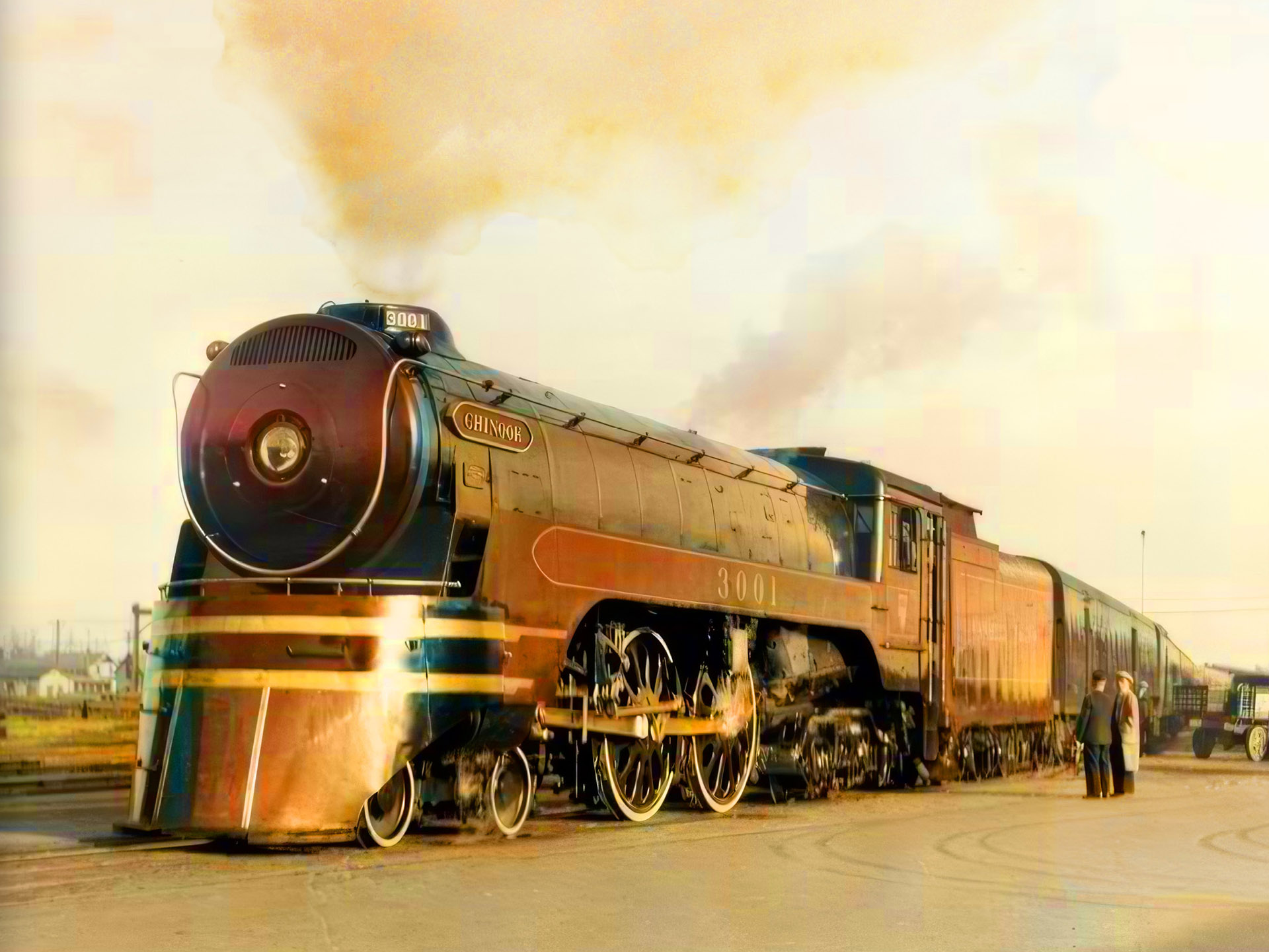
Built in Montreal, the 3000 ‘Jubilee’ series of locomotives was designed to carry passengers at speed between cities. In 1936 the 3000 set a Canadian locomotive speed record of 112.5 mph (181 km/hr) placing Canada in the top tier of railway engineering with Britain, Germany and the US.
Before our eyes, the track emerges: from maps to crews on the ground. Sunrise to sunset and into the night, workers and machines march the line toward completion: from earthmoving and bridge and viaduct building, to the installation of track structure with seamless welded rails, power supply and distribution, perimeter fencing, signalling and track monitoring systems. Kilometre-by-kilometre, a rail system is forged. It is remarkable and new, but in a sense, a natural progression of a project started long ago.

The new train system comes to life. A launch ceremony. The first tests of a new trainset. Engineer training. Proofs of performance. A record-breaking run. As Fast Train concludes, we witness perhaps, the first jubilant passengers gaping out the windows as country scenes flash past. The creation of distinct, electrified passenger rail corridors is a leap that enables passenger transport to advance to higher speeds and greater efficiency – compressing geography, overcoming the congestion of freight rail tracks and the inefficiencies built into the physics of road and air transportation (i.e., road friction and the high energy cost of producing lift).

Production
Context. Re-tooling for a new era, the Government of Canada and the Alto high-speed rail consortium are pursuing the realization of a dedicated high-speed rail corridor between Quebec City and Toronto. To be the first of it’s kind in Canada and one of the fastest in North America, the project represents an important leap for Canadians, and a natural strategic step for a nation built on a railway foundation.
While the new high speed line will take time to build, Fast Train will take audiences there first.
The Project. The Stephen Low Company will produce a high impact giant screen (IMAX®) film about the new rail system, harnessing the power and reach of IMAX® and giant screens and high-fidelity cinema to involve audiences in the remarkable work of engineering Canada’s 21st century transportation solutions.
- Releasing: 2029
- Produced by: The Stephen Low Company
- Distribution: Low Films International Inc.
- Capture: filmed for IMAX® and ultra-high-definition digital