
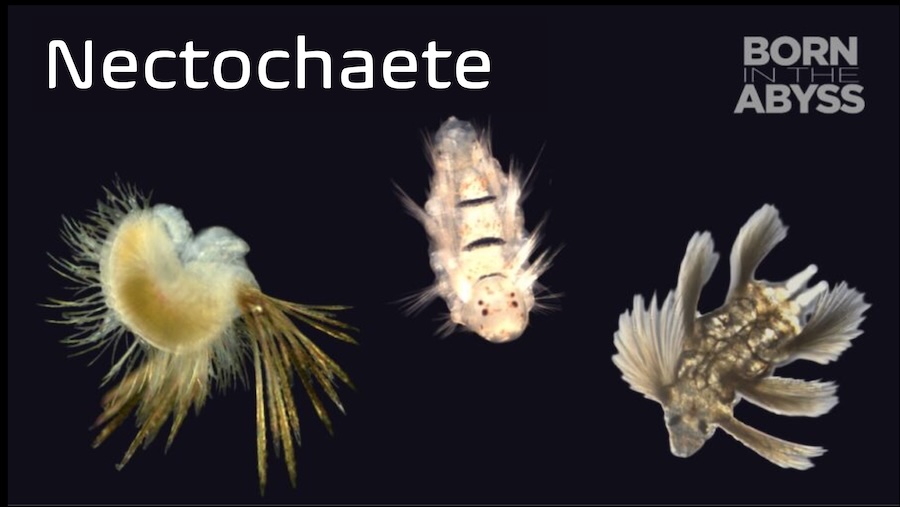
Nectochaete
Plural: Nectochaetes
From the Greek words "nekto" meaning "to swim" and "khaítē," which means "flowing hair"
Parents: Segmented worms called polychaetes
Food: Microscopic algae called phytoplankton and other tiny animals called zooplankton
Size: About 800 microns tall = 0.8 millimeters = 0.03 inches
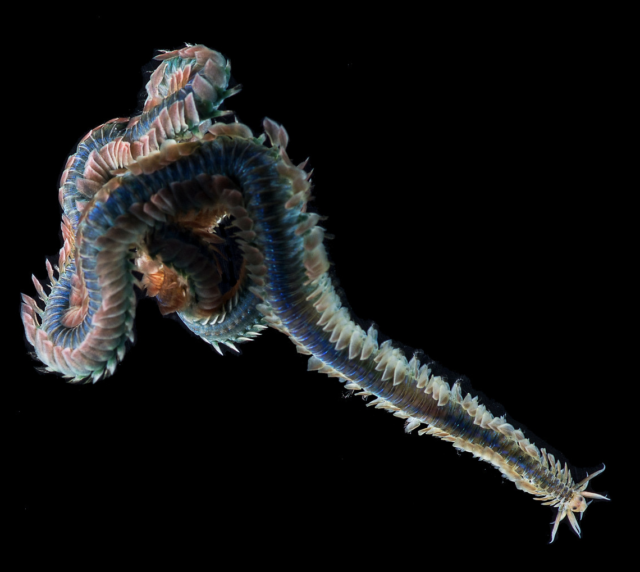
Photo of an adult polychaete worm by McKenna Hainey
Larval Form and Function
Watch this compilation video to learn more about the movement, anatomy, feeding, and metamorphosis of the pluteus larva.
Life Cycle of a Polychaete Worm
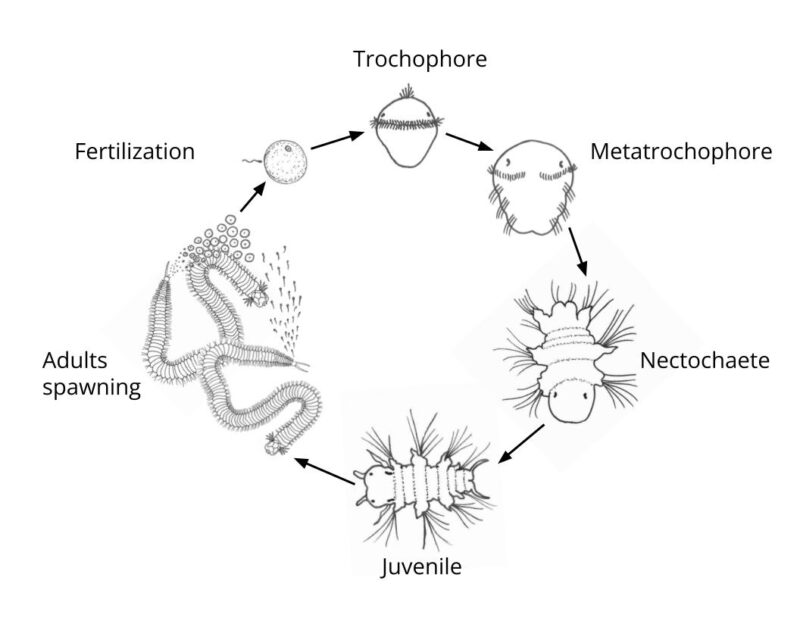
Drawn by Nadia Stoker
- The nectochaete larval form occurs in many polychaete worms, but is usually preceded by a trochophore larval stage.
- Adult segmented worms are typically either male or female, but some are both (hermaphrodites).
- Eggs and sperm are typically spawned into the seawater, where fertilization occurs.
- Polychaetes typically spend days to weeks as larvae, feeding on phytoplankton and zooplankton; however, some species have larvae that do not feed. Adult segmented worms can live from a few months to several years and eat a variety of foods, depending on the species.
- As juveniles, polychaetes start developing their more advanced adult eye, but still retain their larval eyes, which can only see light and dark.
Larval Quest Activity
Developed by Nadia Stoker, Caitlin Plowman, and Trish Mace as outreach and education materials accompanying the Born in the Abyss film.
Oregon Institute of Marine Biology, University of Oregon
Funded by the U.S. National Science Foundation (award #2215692)
All Larval Quest materials are licensed under creative commons license CC BY-NC-SA 4.0.